
The Colour of a Hundred Years

Time can be treated as a river, as something eternal, or as a scarce resource. Today I want to focus on time as a material, an ingredient you can create with, and share the story of the tea caddy I could not talk myself out of.
A chef ages a piece of meat or fish to tenderise it and concentrate its flavours. The potters of Asahiyaki, in Uji, collect and store clay for 40 to 50 years to let its character and qualities settle. Here time does its work before the making begins. With Kaikado tea caddies it works the other way round: made in Kyoto since 1875, they are designed to age beautifully through everyday use, as the oils from your fingers transfer onto them.
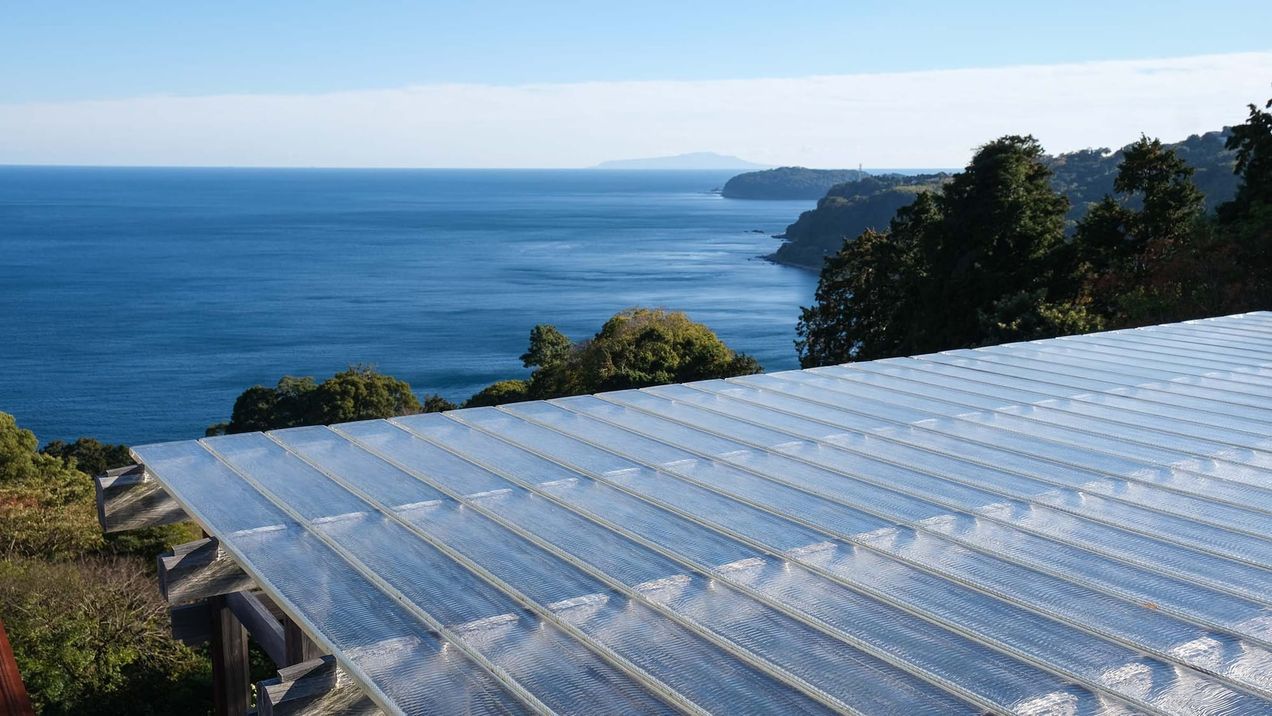
Occasionally, time stops being a process and becomes the material itself. Earlier this year I found out that Takahiro ‘Taka’ Yagi, master craftsman and sixth-generation head of Kaikado, was working with the discarded copper sheets from the roof of an ancient Japanese shrine. The roof was being replaced. After 100 years in the open, the copper had weathered to muted shades of grey and green.
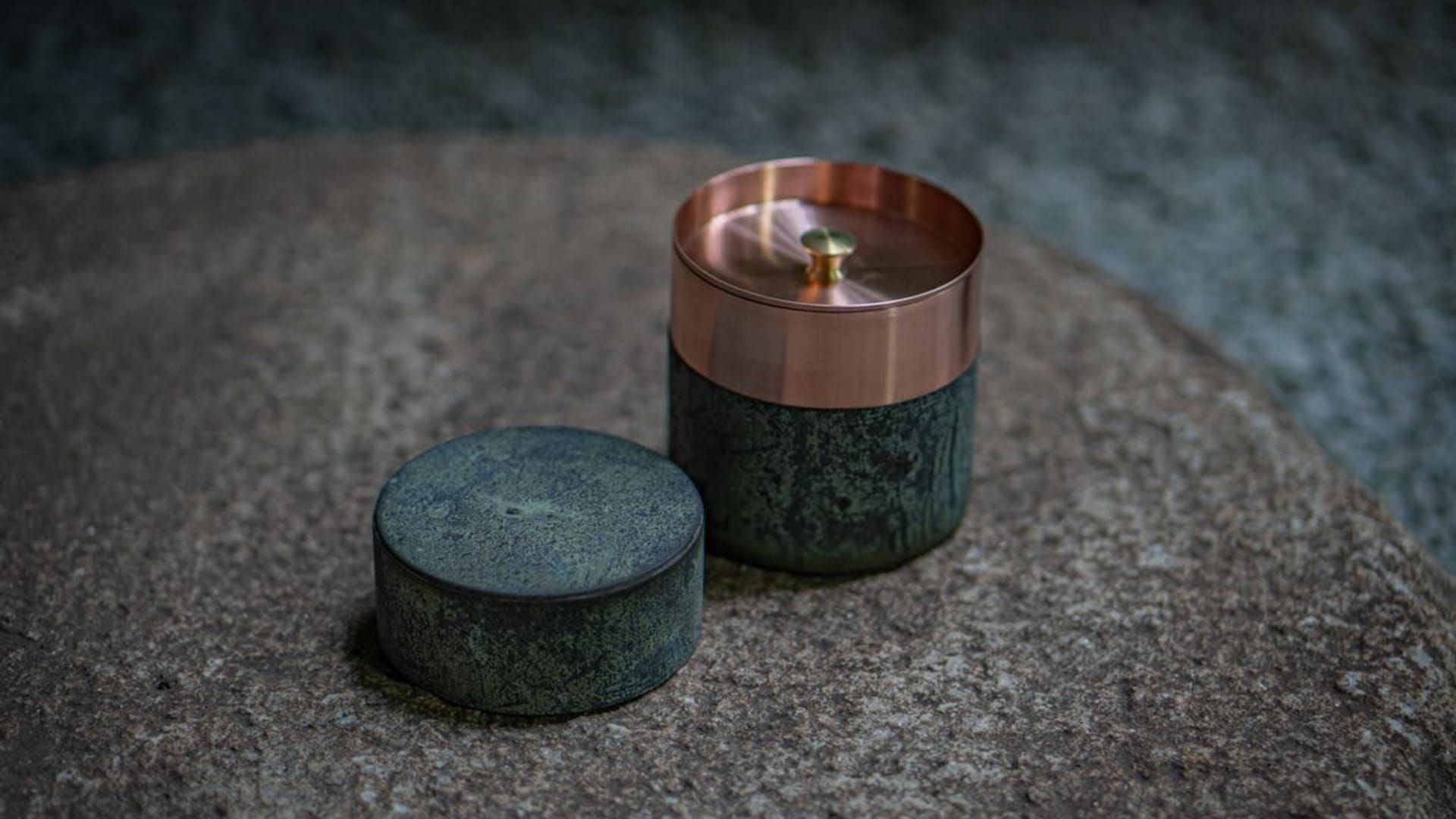
Verdigris is a word for the colour of the patina that forms on copper or brass. It is thought to come from the French term ‘vert-de-Grèce’ which refers to the beautiful green on classical Greek bronze sculpture. — From the exhibition text at Postcard Teas
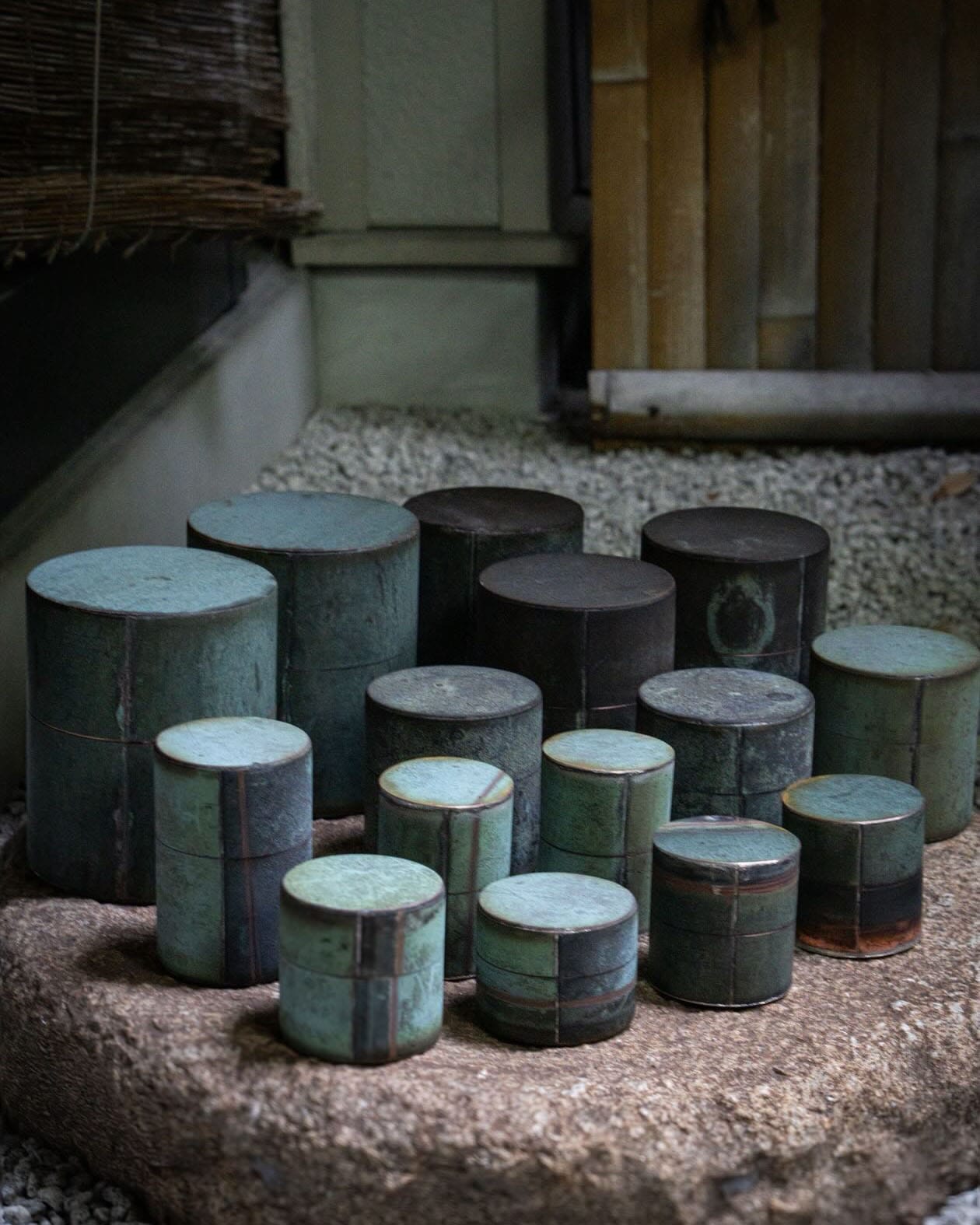
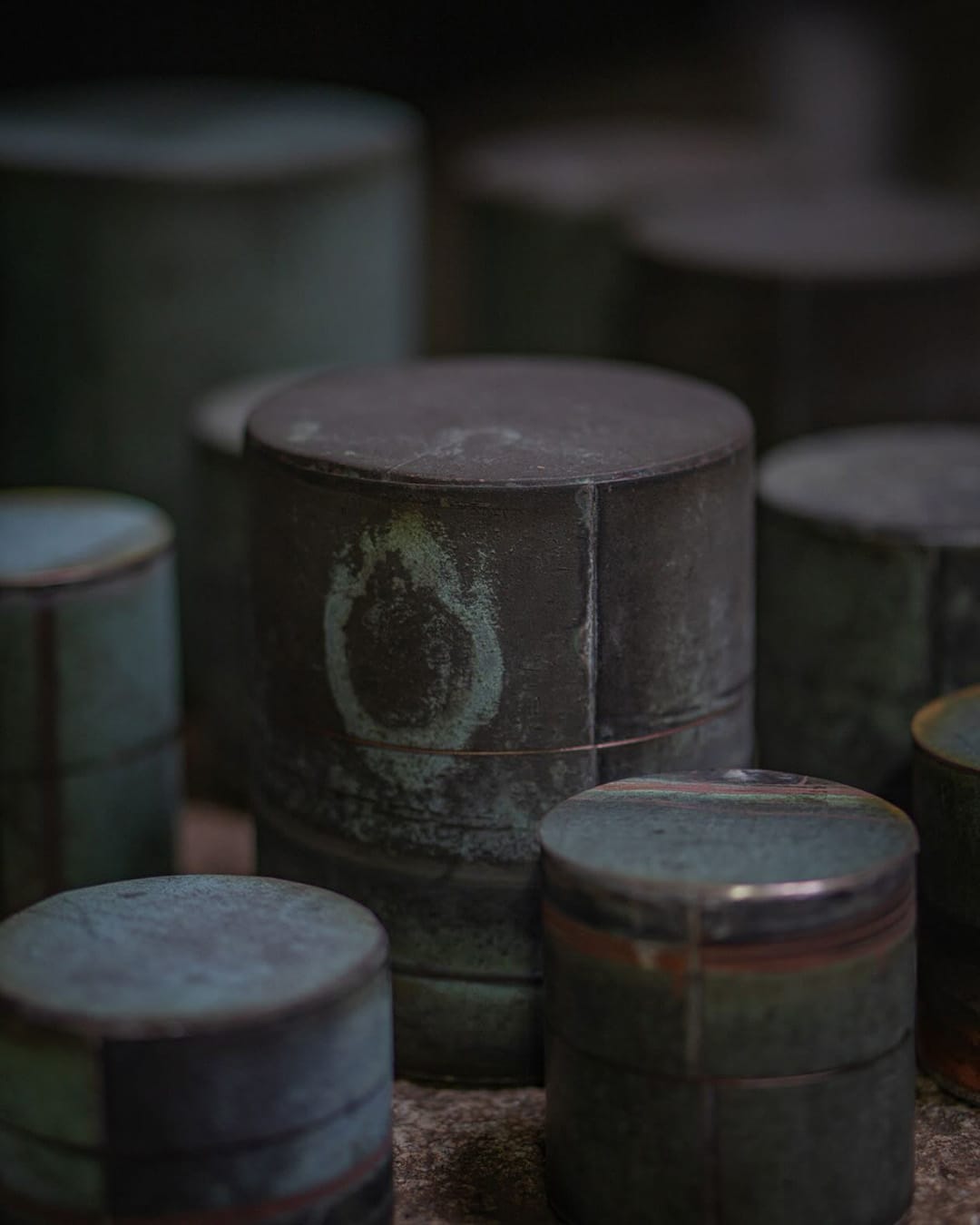
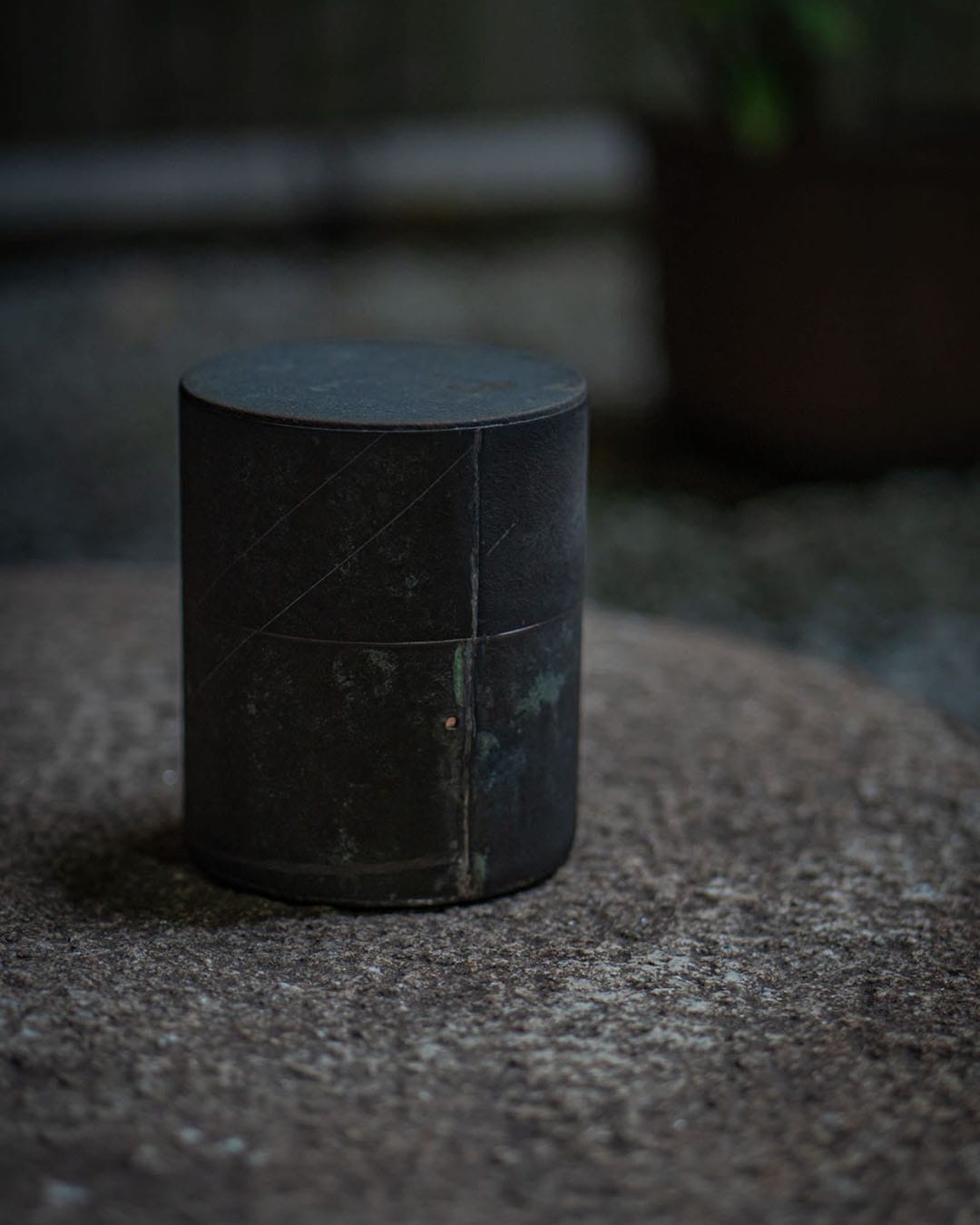
Kaikado Verdigris tea caddies. Photos courtesy Takahiro Yagi
The material was scarce and brittle. Taka would turn it into a series of tea caddies to be shown at Postcard Teas in London. The shop, owned by Tim d’Offay, has been in large part responsible for making Kaikado well known outside Japan.
This is how Taka described the inception of the Verdigris tea caddies:
This project began about two years ago in London, from a simple conversation with Tim over tea. “People here seem rather fond of green,” I said — noticing it everywhere, from uniforms to small details in the city and of course London’s parks. “Perhaps,” he replied, “but it’s a different green from Kyoto.” From that moment, the idea grew: what if “green” became the theme of the next exhibition?
As soon as I heard about it, I felt an irrational urge to have a Kaikado Verdigris. Irrational because, as a freelance consultant in an unstable economy, I have no business investing in such an object. I also didn’t need another tea caddy. But I could sense that this was not just a pang of materialistic desire.
When the exhibition opened I would be speaking at a conference in Athens: the right country for the colour, the wrong one for the show. I wrote to both Taka and Tim to ask whether I could still acquire one. A few major museums and other collectors wanted one too, and only about 15 pieces were made.
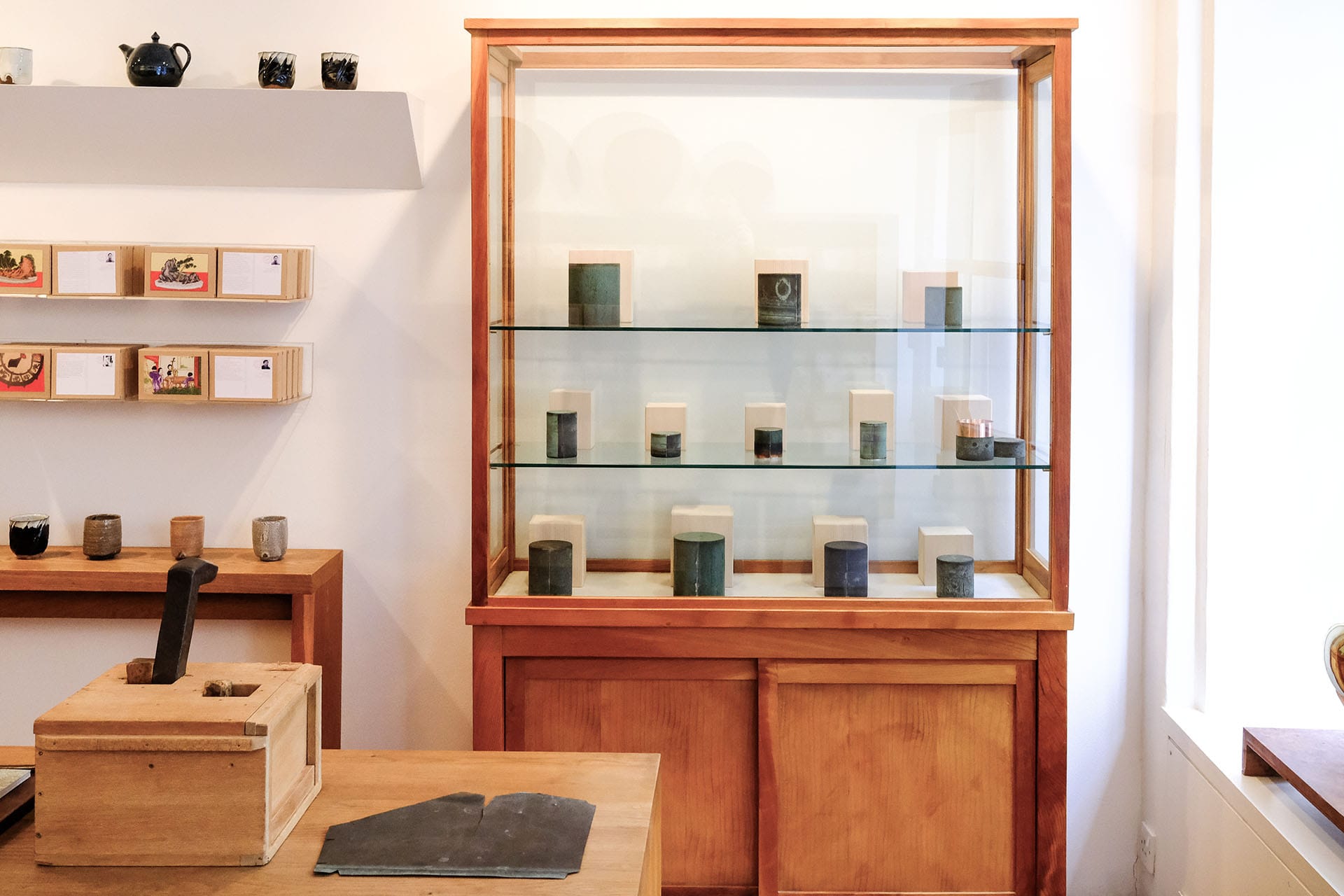
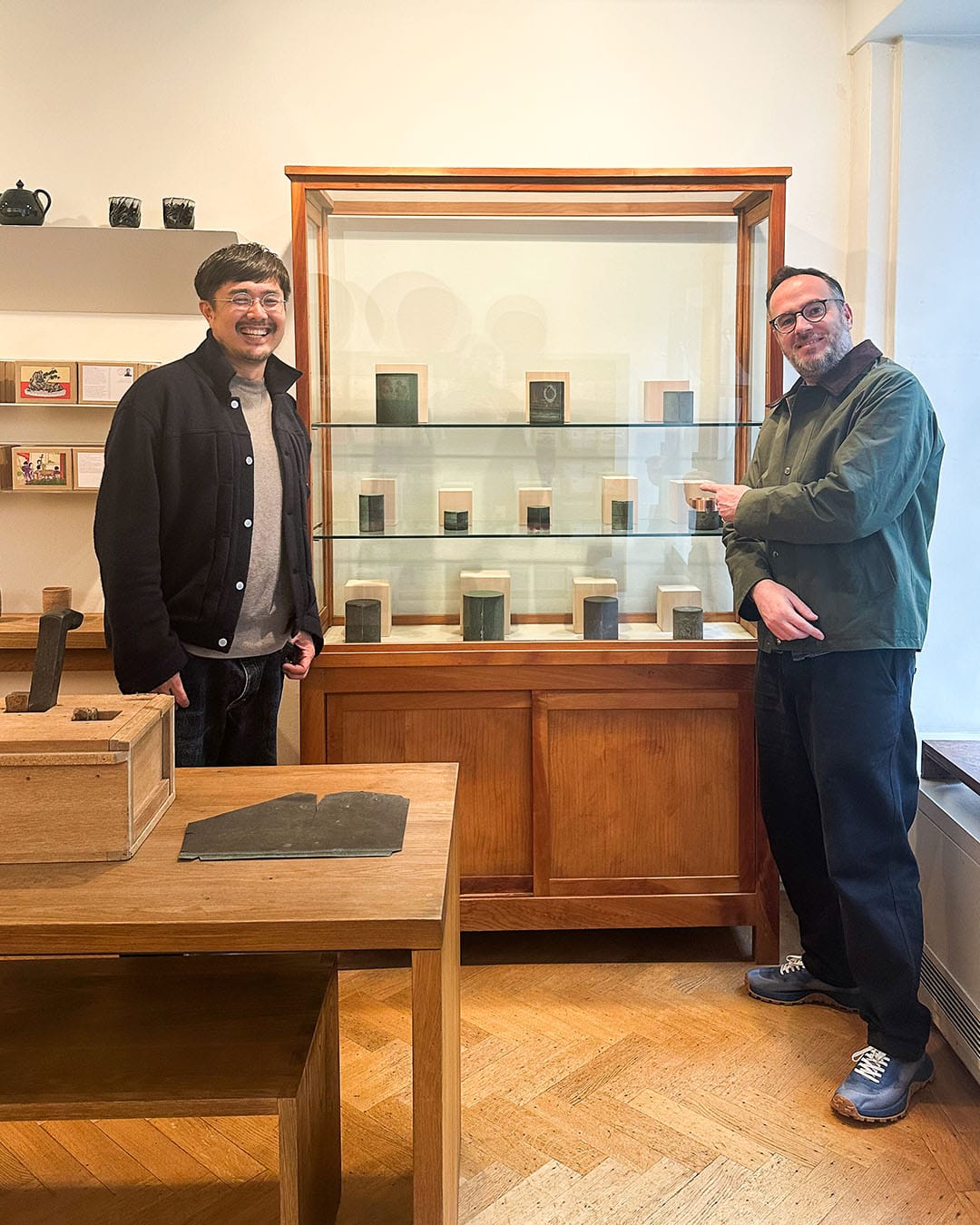
Kaikado Verdigris exhibition at Postcard Teas. One of the raw copper sheets is on the table. With Taka on the closing day. Photos courtesy Postcard Teas
I usually wouldn’t buy an object like this without holding it in my hands, but I had to be quick. Tim sent photos of the caddies still available. I chose mine while boarding a plane, keeping my phone on until the last moment before take-off. I missed the opening but made it back to London on the closing day, in time to catch Taka before he returned to Kyoto. I saw the caddies in person, but left without mine.
Thinking about what attracted me to the Kaikado Verdigris, I came up with four reasons why this example of time as a material feels so powerful to me.
The time in the material
The copper sheets from the shrine’s roof gained their character over a century, before the craftsman’s intervention. No two sheets were alike. “Each carried its own green”, Taka wrote, “some deep, some pale, some flickering like foxfire, and all marked by time.” It’s a process that can’t be hurried and it’s akin to how we develop our personality and understanding of life by living it.
Using this material from the earth but marked by the heavens for around 100 years, he has created objects which have incredible power but also a purpose. — From the exhibition text at Postcard Teas
The time in the maker’s hands
I’ve known Takahiro Yagi since 2013 and believe that he’s one of the most important craftspeople of our generation. Born in 1975, he probably could not have made the Verdigris caddies at 25. Old copper does not cooperate. “Some resisted shaping, some could not be soldered easily, each behaved very differently under heat”, Taka wrote. He had to hone his skills and his taste over time to deliver such a wonderful object. The Verdigris caddies reflect the maturity of the maker as much as that of the material, and I’m in awe of watching it happen.
The lid of a Kaikado caddy descending under its own weight. Video by Gianfranco Chicco
The time still to come
The Verdigris caddy will keep changing, as my other Kaikado caddies have over the past decade. I like the Japanese word unson (雲孫, cloud descendant), used for a descendant eight generations away. It makes them tangible even though they are as distant and unreachable as clouds. Someone’s unson might one day hold this caddy. I can only imagine what it will look like by then.
The time in me
Finally, it’s the moment it reached me in my own life. I’m in a period of change (aren’t we all?) where I’m reflecting on my craft and what the experience I have developed in the last 25 years is worth. There’s also my relationship with Japan, my research into why shokunin (職人, artisan) culture matters now more than ever, and the important role that tea plays in how I live. This cylindrical object silently speaks to all of those.
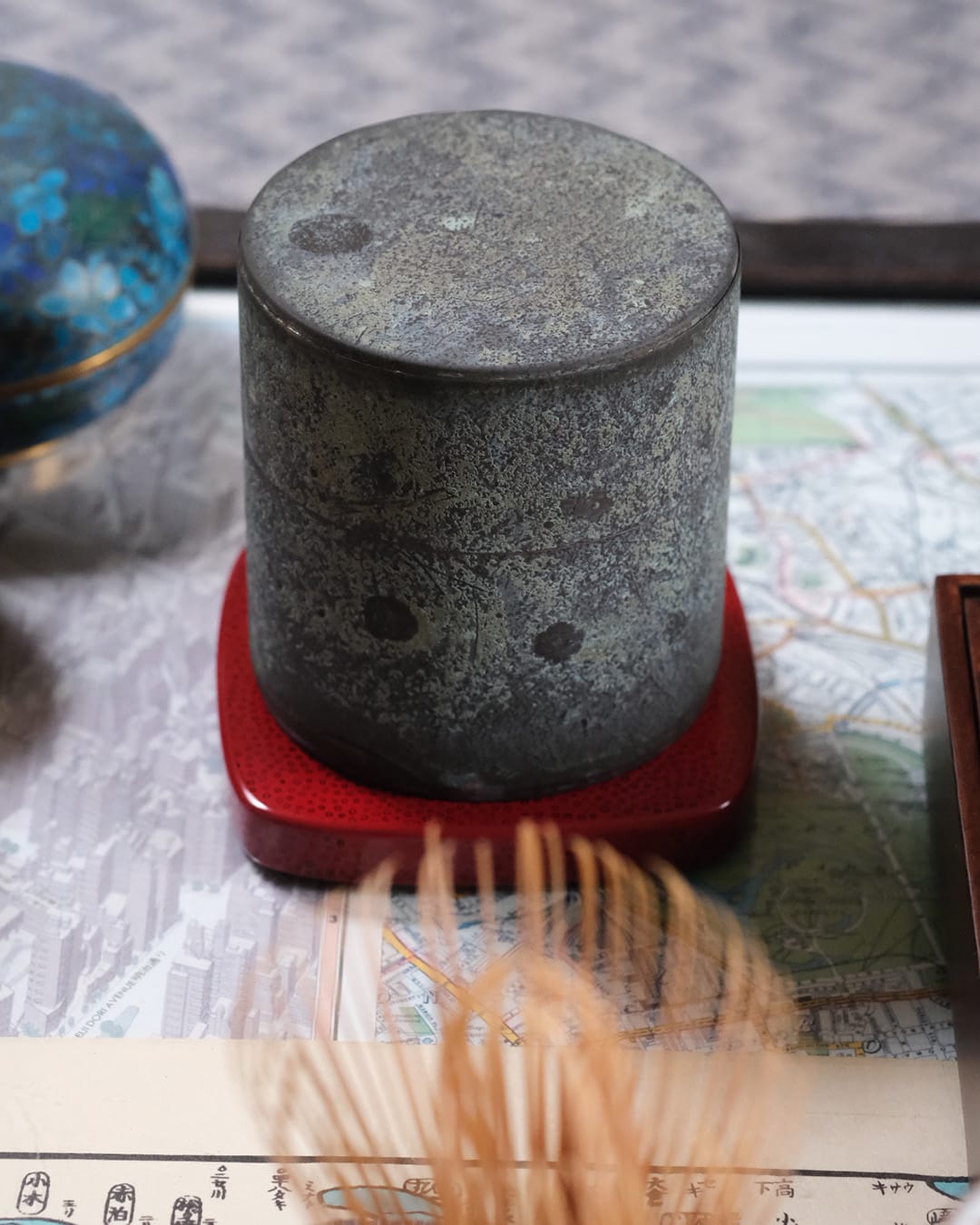
I held my caddy a few weeks later. It is a 120g version, 81mm tall and 78mm across. The verdigris patina, rokushō (緑青) in Japanese, has two spots that look like eyes. They reminded me of the Makkuro Kurosuke — the soot creatures — in Hayao Miyazaki’s Studio Ghibli films. Mine is green (midori, 緑) rather than black (kuro, 黒). I called it ‘Midori Midorisuke’ in their honour.
Taka, thank you for bringing these beautiful objects into the world.
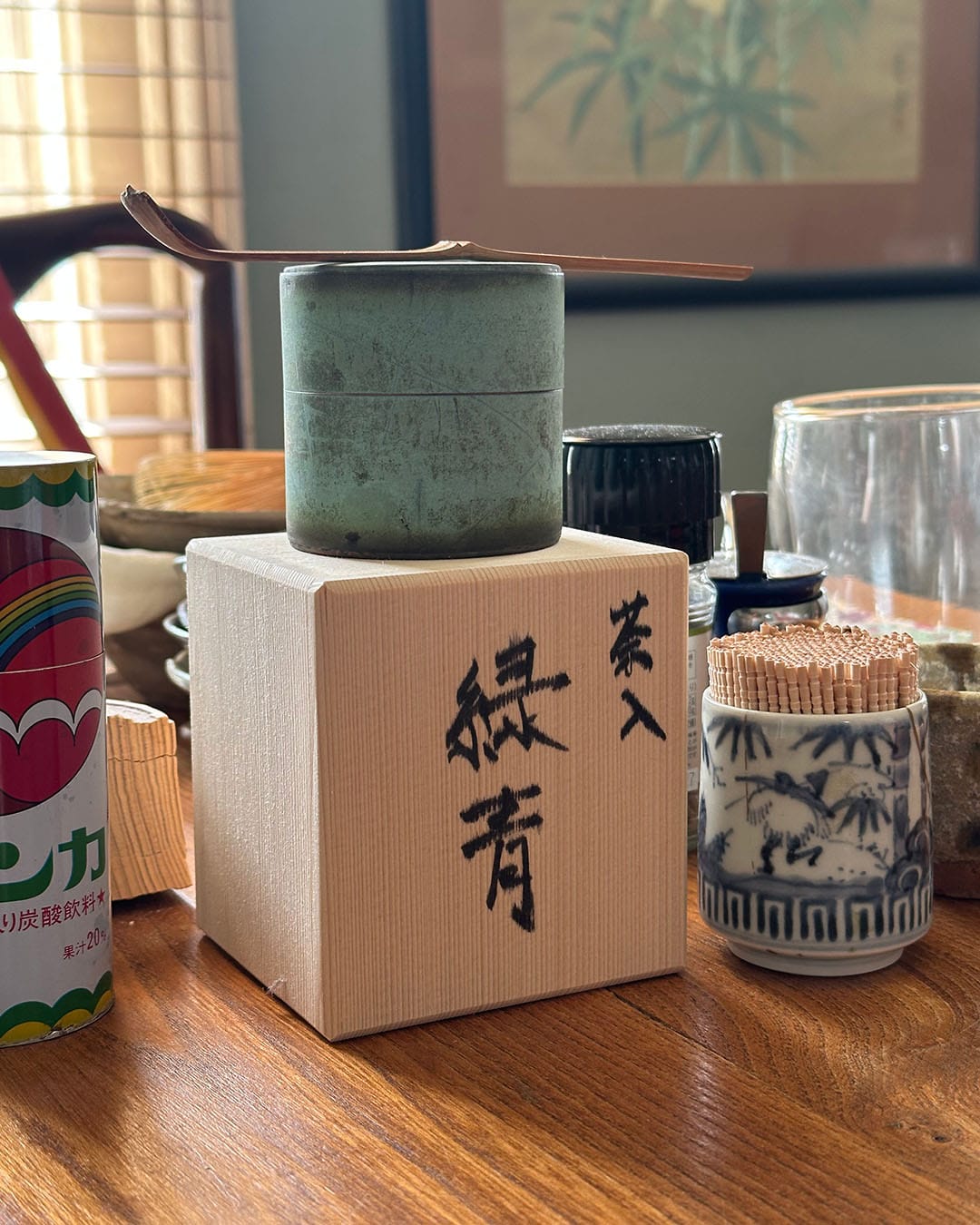
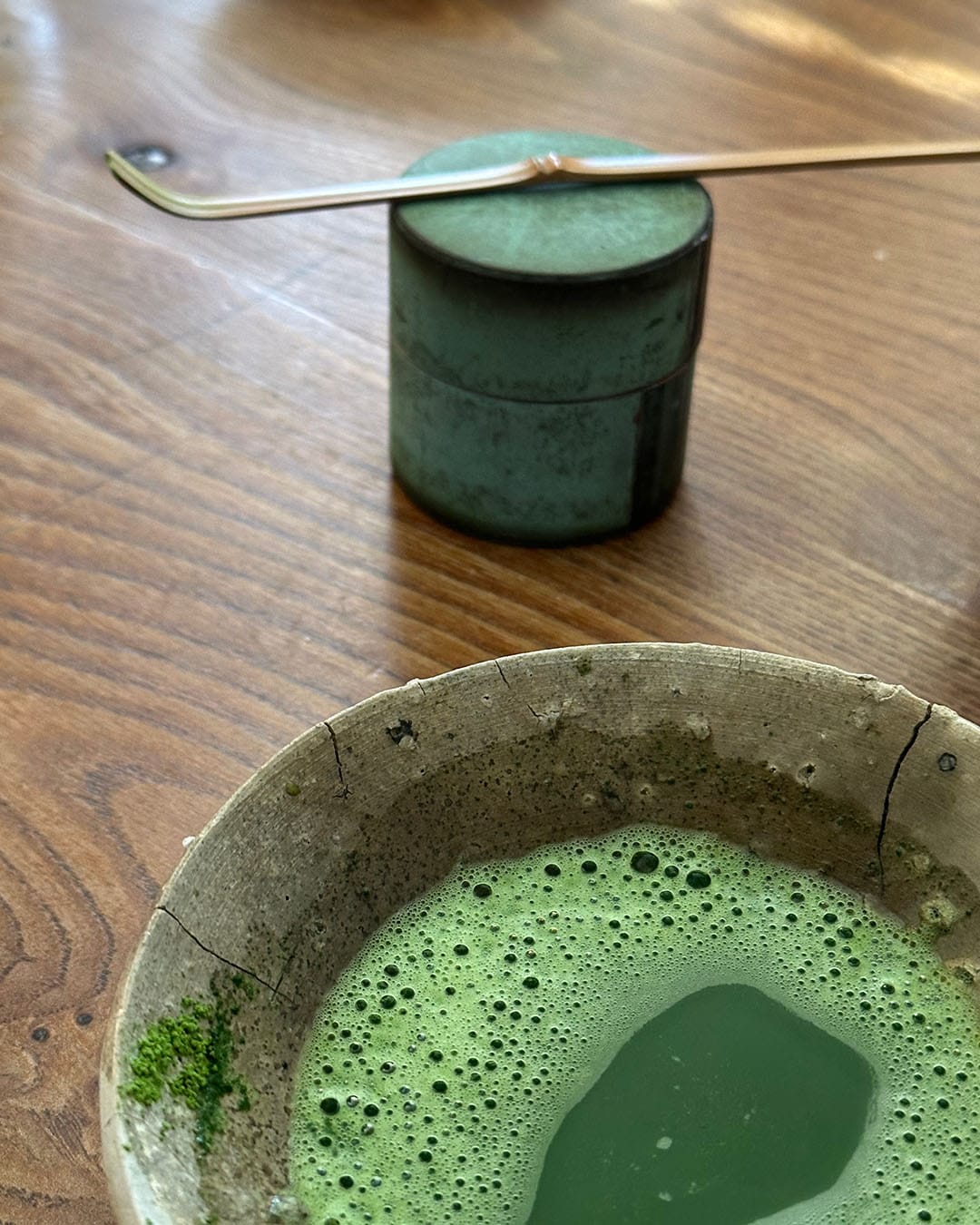
Having tea in July with my friend Athico, who also has a Kaikado Verdigris. Photos by Gianfranco Chicco
Note: The Kaikado Verdigris exhibition ran at Postcard Teas in London from 8 to 12 May 2026.
Post scriptum
A few books and articles about time.
Books
‘The Good Ancestor: How to Think Long Term in a Short-Term World’, by Roman Krznaric
‘Four Thousand Weeks: Time Management for Mortals’, by Oliver Burkeman
Articles
‘Welcoming Uncertainty: A conversation with ceramic artist Hosai Matsubayashi XVI’, Musubi Academy
Where I came across unson.
‘The Myth of Succession: On Letting the Clay Sleep’, by Hosai Matsubayashi XVI
Hosai, interviewed in the Musubi Academy piece above, has recently started his own newsletter in English. In this issue he talks about how Asahiyaki’s practice of ageing clay for decades came to be.
Enjoying The Craftsman? You can support my work by offering me a virtual coffee ☕️
つづく