
The Opposite of Sameness - Lecture at Domus Academy

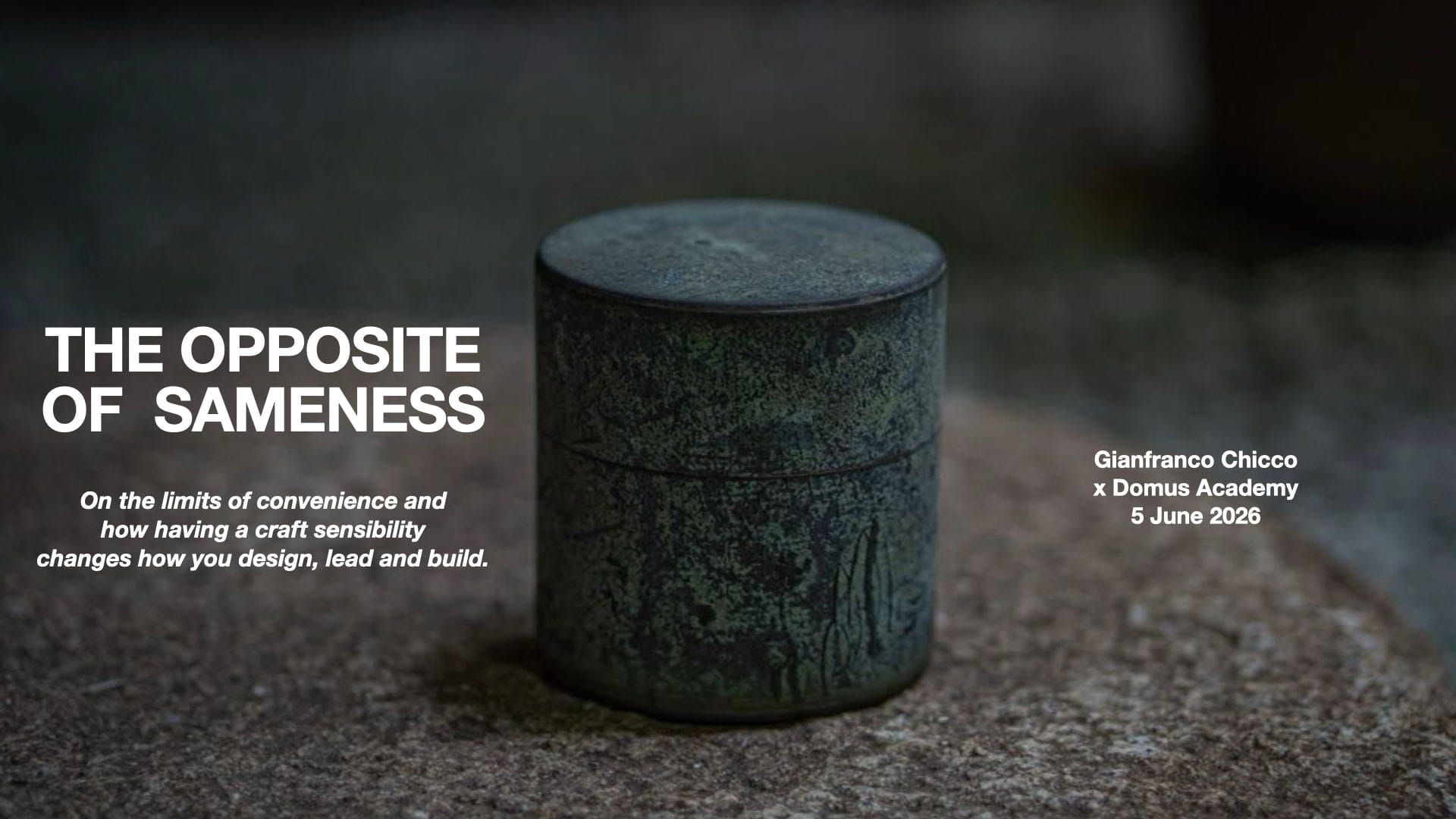
On the limits of convenience and how having a craft sensibility changes how you design, lead and build.
On 5 June 2026, I gave an online lecture for master's students at Domus Academy, Milan, across disciplines including fashion, design, and business. What follows is a summary of the main argument and the four parts that structured the 90-minute session. I’ve included links to various issues of The Craftsman Newsletter where I expanded on each topic.
The central premise is this: for decades, friction was the enemy. Globalisation and digitalisation made it progressively easier to create, sell, and distribute. But somewhere in the process we passed a tipping point. Premium became abundant. Generative AI, built on averages, is now used at scale for copywriting, image and video generation, and designing everything from websites to products and fashion. The result is a “Default of Sameness”, a world where the absence of resistance produces work that circulates without leaving a mark.
The lecture argued that craft sensibility, understood as a philosophy, a hands-on discipline, and a way of seeing, is what separates work that lasts from work that merely circulates. I offered my perspective through the lens of Japanese craftsmanship, not as a formula or a romanticised idea, but as a different way of thinking about how we live and work.
Before starting, I asked the participants to think about one object that they would never throw away. The answers varied from a guitar, to a childhood plushie, jewellery and various gadgets.
The session was structured in four parts.
PART I:THE EPIPHANY
The first part introduced the problem and my own trajectory into this subject: how working in digital media, surrounded by the immaterial and people living and working “from the neck-up”, led me to the shokunin (職人, craftsperson in Japanese) as a counterpoint.
The word carries more than its translation suggests. A shokunin is not simply someone who has mastered a craft. The role implies social responsibility, synchronicity with nature, and an understanding of what is enough. The ideogram itself makes this clear. On the right, 人 means person. On the left sits 耳 (mimi, ear): to be a craftsperson, the first prerequisite is the capacity to listen. Not as a metaphor, but as a physical act. A shokunin listens to the sound of their tools working on the material to understand when they’re doing it right. But also to the needs of the community they serve. Next to 耳 sits 戠 (shiki), a compound of tool and sound that historically refers to the act of working clay or incising a mark into an object. Together, the two sides of the ideogram describe the full arc of craft: sensory attunement and the human imprint that endures.
This is the opposite of neck-up existence. It is knowledge anchored in the body, in material, and in time.
PART II: THE PATH TO MASTERY
The second part explored three dimensions to frame Japanese craftsmanship: deep learning, circularity and enough.
Shu-ha-ri (守破離), establishes the stages to become a master craftsperson. Copy the rules, break the rules, find a new balance and create new rules, become the rules. Read more about Shu-ha-ri.
Craftsmanship and circularity are one. Sustainability is not a corporate PR box to check or an act of altruism. Longevity, avoiding waste, repairability and upcycling are systemic. The goal is not only to preserve materials and traditions, it also fosters lasting relationships between makers, their tools, and the people they serve. Read more about craftsmanship and circularity.
The notion of knowing what is enough has changed how I see the world, especially when everything and everyone, especially in business, seems obsessed with scale and growth at all costs. Read more about contentment, rooted in the Buddhist teaching Ware Tada Taru wo Shiru (吾 唯 足 知) — I only know enough.
This section ended on a reflection on Artisanal Intelligence vs Artificial Intelligence. Read more about it here.
PART III: ALIVENESS AND CRAFT VS. CRAFT-WASHING
The third part examined the line between genuine craft and craft-washing: the use of craft language and aesthetics to signal quality without the underlying commitment. At a moment when luxury leaders invoke taste and curation as a counterbalance to AI, the ability to distinguish one from the other is critical.
I invited the participants to reflect on the object they said they would never throw away:
- Would it evolve with time? Become better?
- Does it carry a feeling of nostalgia?
- Could they feel the hand of the maker in it?
- Did it involve real craft or craft-washing?
- Could human curation or taste be an antidote to AI’s sameness and the over-abundance of content?
I shared my own chosen object, a ‘verdigris’ tea caddy made by Takahiro Yagi from Kaikado using weathered copper from the roof of an ancient shrine that had been exposed to the elements for 100 years.
We then reflected on how you would pitch a product to a modern venture capitalist or consumer when its chief feature is that it takes a century to mature.
PART IV: MAKING, DETAILS & CARE
The final part offered a guide of possible paths for the participants to apply a craft sensibility to their practice. I shared this message via three quotes:
“Fabrico, ergo intelligo.” - Enzo Mari (Read more)
“The details are not the details. They make the design.” - Ray and Charles Eames
“一期一会” (Ichi-go, ichi-e, one time, one meeting) - From Zen and tea culture
Care is a superpower. In a world of infinite sameness, the capacity to care, to understand through making, to focus on the details that matter, and to treat each encounter between host and guest (maker and consumer, salesperson and customer, etc) as unrepeatable is the only position that cannot be averaged out.